

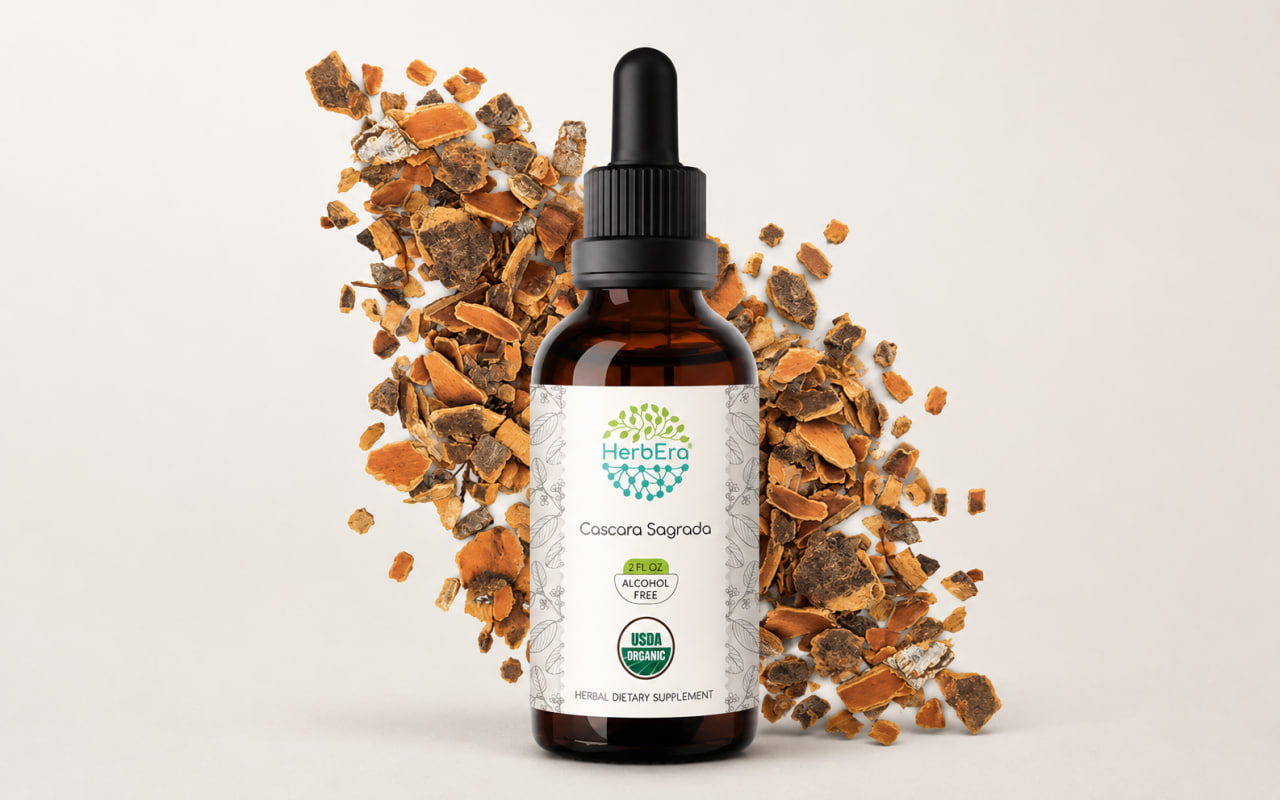
Cascara Sagrada Tincture vs Capsules is not just a format question. It is a serving-control question. Cascara sagrada is usually made from the bark of Frangula purshiana, also known in older references as Rhamnus purshiana. Because cascara products can have stronger safety considerations than many everyday herbal supplements, the way you measure and follow the label matters.
A tincture gives flexibility because the serving may be measured in drops, droppers, or milliliters. Capsules give simplicity because each capsule contains a fixed amount. Neither format is automatically better for everyone. HerbEra treats this kind of comparison as a practical label-reading decision: choose the format you can measure correctly, use consistently, and avoid exceeding.
This guide compares cascara sagrada tincture and capsules for serving precision, taste, travel use, storage, missed servings, label clarity, and safety checks. It does not promise results or replace professional guidance.
What Is the Main Difference Between Cascara Sagrada Tincture and Capsules?

The main difference is how the serving is measured. Cascara sagrada tincture is a liquid extract measured by drops, droppers, or milliliters. Cascara sagrada capsules contain a fixed amount per capsule or per serving.
A tincture may feel more adjustable because the user can measure a smaller or larger liquid amount within the label directions. Capsules feel simpler because the serving is already portioned. That simplicity can reduce guessing, especially for beginners.
The practical answer
If you want the least measuring, capsules are usually easier. If you need a liquid format and are comfortable reading dropper directions, tincture may fit better.
With cascara, do not self-increase either format. Follow the product label and ask a qualified healthcare professional if the directions are unclear or if risk factors apply.
Why Serving Control Matters with Cascara Sagrada
Serving control matters because cascara sagrada should not be treated like a casual spice or mild tea. Cascara products are often discussed with cautions around recommended dosage, duration of use, digestive symptoms, dehydration, electrolyte concerns, medication use, pregnancy, nursing, and medical conditions.
The issue is not only whether the product is a tincture or capsule. The issue is whether you can follow the label exactly and avoid open-ended use.
Do not use more because the format feels easy
A liquid serving can look small. A capsule can look ordinary. Neither visual cue tells you that more is appropriate.
Do not add extra drops, extra capsules, or extra days because you think the product should work faster. The label is the first limit, not a starting suggestion.
Cascara Sagrada Tincture vs Capsules: Quick Comparison
The best format depends on how you measure, travel, handle taste, and follow directions. Use this table as a decision guide, not as medical advice.
| Feature | Cascara sagrada tincture | Cascara sagrada capsules |
|---|---|---|
| Serving style | Drops, dropper, or milliliters | Fixed capsules per serving |
| Measuring effort | Requires careful measuring | Usually easier to count |
| Adjustability | More flexible within label directions | Less adjustable unless label gives options |
| Taste | Bitter bark taste is noticeable | Less taste unless capsule leaks or causes aftertaste |
| Travel use | More spill risk | Usually easier to pack |
| Best for | Users comfortable with liquid serving directions | Users who want less measuring and less taste |
If you often misread droppers, capsules may reduce serving confusion. If you dislike swallowing capsules, a tincture may feel easier, but only if you can measure it accurately.
Is a Tincture More Precise Than Capsules?
A tincture can be precise when the label gives clear milliliter markings and the user measures carefully. It can be less precise when the user guesses with a dropper, changes droppers, or assumes a full glass pipette is the serving.
Capsules can be more predictable for beginners because the serving is usually counted: one capsule, two capsules, or another fixed amount. But capsules are less adjustable if the label does not provide a smaller serving option.
Dropper directions need attention
If a tincture label says drops or dropperful, use the included dropper. Do not use a dropper from another bottle. Do not force the glass pipette to fill to the top unless the label tells you to use a marked line.
If the label gives milliliters, use the marking on the dropper only if it is clear and matches the instruction.
Are Capsules Easier for Beginners?
Capsules are often easier for beginners because they remove liquid measuring. You count the capsule serving and follow the timing on the label. That can reduce accidental overuse caused by uncertain drop counts.
However, capsules can create their own mistakes. People may take extra capsules because they seem small, split a serving incorrectly, or ignore warning statements.
Fixed serving does not mean risk-free
A fixed capsule amount can make the routine easier, but it does not make cascara automatically appropriate for every person.
Read warnings about pregnancy, nursing, medication use, medical conditions, digestive concerns, and duration. Ask a qualified professional when those warnings apply.
Which Format Is Better for Avoiding Bitter Taste?
Capsules are usually better if you want to avoid cascara sagrada’s bitter bark taste. Tinctures expose you directly to the liquid extract, so bitterness is more noticeable.
Cascara is also known as Bitter Bark, so bitterness can be normal. Still, normal bitterness is different from a moldy smell, sour odor, broken seal, leaking bottle, or expired product.
How tincture taste affects use
A bitter tincture may tempt people to add it to juice, take it quickly, or avoid full servings. If the label allows dilution, use a small amount of water and finish the full serving.
Do not add extra drops because you diluted the taste. Dilution changes flavor, not the intended serving.
Which Format Is Better for Travel?
Capsules are usually easier for travel because they are less likely to spill and easier to count. Tinctures need a tight cap, a protected glass bottle, and attention to liquid travel rules if you fly.
Travel also disrupts routines. Capsules may be simpler when meals, schedules, and time zones change.
Travel checklist for tinctures
Keep the tincture in the original bottle with the label visible. Tighten the cap, place it in a sealed bag, and keep it away from heat. Do not leave it in a hot car.
If the bottle leaks, the dropper cracks, or the seal looks compromised, do not use it until the seller responds.
Travel checklist for capsules
Keep capsules dry, sealed, and away from heat. Travel pill cases are convenient, but the original bottle keeps the lot number, expiration date, label directions, and warnings available.
If you move capsules to a small container, keep the original bottle with you or take clear photos of the label.
Which Format Is Easier to Store?
Capsules are usually easier to store because they do not spill and do not require a dropper. Tinctures need extra attention to the cap, dropper cleanliness, and liquid appearance.
Both formats should be stored as directed on the label. In general, avoid heat, sunlight, humidity, loose caps, bathrooms, cars, and damp bags.
Storage affects quality
Liquid tinctures can change if the dropper touches your mouth, hands, cup rim, or countertop. Capsules can become sticky, swollen, or clumped if exposed to moisture.
Do not use either format if the product smells moldy, looks damaged, is expired, or arrived with a broken safety seal.
How to Compare Labels Before Buying
Compare the label, not just the format. Two cascara products can differ in serving size, plant part, liquid base, capsule amount, warnings, storage instructions, and suggested duration.
Look for cascara sagrada, Frangula purshiana, Rhamnus purshiana, bark, extract, serving size, suggested use, warnings, lot number, expiration date, and storage directions.
| Label detail | Why it matters | What to check |
|---|---|---|
| Serving size | Controls how much is used at once | Drops, mL, capsule count, or mg |
| Frequency | Shows how often the product is intended to be used | Per day wording and maximum directions |
| Plant identity | Confirms the ingredient | Frangula purshiana or Rhamnus purshiana |
| Plant part | Cascara products usually focus on bark | Bark or bark extract wording |
| Warnings | Shows who should avoid or ask first | Medication, pregnancy, nursing, conditions |
| Storage | Protects product quality | Cool, dry place and cap instructions |
HerbEra’s product-style positioning makes this comparison straightforward: do not choose the format by habit alone. Choose the format whose serving instructions you can follow without improvising.
What If You Miss a Serving?
If you miss a serving, do not double the next serving unless the label specifically says to do that. With cascara, catching up by taking extra is not a safe assumption.
Return to the label-based routine. If you keep missing servings, reconsider whether the format fits your life. Capsules may be easier for routine tracking. Tinctures may be easier for people who dislike swallowing pills.
Do not build your own catch-up plan
Do not take extra capsules, extra drops, or an extra serving to compensate for a missed one. If you are unsure what to do, ask a qualified healthcare professional or the product support team.
Write down when you use the product if you are worried about forgetting.
What If You Want the Most Flexible Serving?
A tincture is usually more flexible than capsules because liquid can be measured in smaller amounts within the label’s instructions. That may appeal to users who dislike fixed capsule amounts.
But flexibility can become a problem if it turns into guessing. A flexible format still needs a clear serving method.
Flexibility requires discipline
If you choose a tincture, learn the label’s measurement language before use. Understand drops, droppers, milliliters, frequency, and dilution directions.
If that feels annoying or unclear, capsules may be the better practical choice.
What If You Want the Least Guesswork?
Capsules usually create the least guesswork because the serving is already portioned. You still need to follow the label, but you do not need to count drops or interpret a dropper fill level.
This can be useful if you travel often, dislike bitter taste, or want a routine that is easy to log.
Capsules are not automatically easier for everyone
Capsules may not suit people who have trouble swallowing pills, need a liquid format, or want more adjustable serving options.
If swallowing capsules leads to discomfort or aftertaste, review food and water timing, or choose another format only after checking the label.
Who Should Ask Before Using Either Format?
Ask a qualified healthcare professional before using cascara sagrada tincture or capsules if you are pregnant, nursing, taking medication, managing a medical condition, preparing for surgery, buying for a child, or using multiple supplements.
Use extra caution if you have digestive disorders, dehydration risk, electrolyte concerns, kidney concerns, liver concerns, frequent diarrhea, abdominal pain, or unexplained digestive symptoms.
Do not use cascara as a health shortcut
Cascara sagrada products should not be used to treat, cure, prevent, diagnose, reverse, detox, cleanse, flush, or manage any health condition.
Do not replace professional medical care, medication, hydration guidance, or evaluation of symptoms with a supplement format choice.
When Should You Not Use the Product?
Do not use cascara sagrada tincture or capsules if the safety seal is broken before first opening, the product is expired, the label is unreadable, the packaging is damaged, or the contents smell moldy, sour, rancid, rotten, or chemical-like.
Do not use a tincture if the dropper is cracked, the bottle leaked, or the liquid has unusual cloudiness, mold, pressure, or unexpected floating material. Do not use capsules if they are wet, sticky, swollen, clumped, leaking powder, or discolored in an unusual way.
Contact support instead of guessing
Send the product name, order number, lot number, expiration date, photos, and a short description of the issue. Keep the bottle and packaging until support responds.
Do not “test” a questionable product by taking more.
Checklist: How to Choose Between Cascara Sagrada Tincture and Capsules
Use this checklist before buying or using either format. It focuses on serving control, label clarity, safety checks, and practical routine fit.
Check the serving format
Look for drops, droppers, milliliters, capsule count, or milligrams. Choose the format you can follow without guessing.
Read the frequency limit
Check how often the product says to use it. Do not exceed the label or create your own catch-up plan after missed servings.
Compare taste tolerance
Choose capsules if bitter bark taste is a major problem. Choose tincture only if you can handle the flavor or dilute as directed.
Consider travel use
Capsules are usually easier to pack. Tinctures need leak protection, the original bottle, and careful storage away from heat.
Check plant identity
Look for cascara sagrada, Frangula purshiana, Rhamnus purshiana, and bark or bark extract wording.
Review warnings
Check pregnancy, nursing, medication, medical condition, digestive, and duration-related warnings before using either format.
Inspect product condition
Do not use a product with a broken seal, expired date, damaged packaging, leaking tincture, cracked dropper, sticky capsules, or off smell.
Ask when unsure
Ask a qualified healthcare professional if you have risk factors. Ask the seller if the label, serving, or product condition is unclear.
FAQ
Is cascara sagrada tincture or capsules easier to measure?
Capsules are usually easier to measure because each capsule has a fixed amount. Tinctures require measuring drops, droppers, or milliliters.
Is tincture more flexible than capsules?
Yes. Tincture can be more flexible within label directions, but it also requires more careful measuring.
Are capsules better if I dislike bitter taste?
Usually yes. Capsules reduce direct exposure to cascara’s bitter bark taste.
Can I take more drops instead of using capsules?
No. Do not increase drops, capsules, or frequency beyond the label unless a qualified healthcare professional gives product-specific guidance.
Which format is better for travel?
Capsules are usually easier for travel because they are less likely to spill and easier to count.
Does a tincture work faster than capsules?
Do not assume that. Format alone does not prove timing, strength, safety, or suitability.
What should I check before choosing a format?
Check serving size, frequency, plant identity, plant part, warnings, storage, expiration date, and whether you can follow the directions accurately.
Should cascara sagrada be used long term?
Do not create a long-term cascara routine without professional guidance. Follow the label and ask if unsure.
Who should ask a healthcare professional first?
Ask first if you are pregnant, nursing, taking medication, managing a medical condition, buying for a child, or using multiple supplements.
Glossary
Cascara sagrada
A common name for bark from Frangula purshiana, also known in older references as Rhamnus purshiana.
Frangula purshiana
A botanical name used for the plant commonly called cascara sagrada.
Rhamnus purshiana
An older botanical name still found in some references and product descriptions.
Tincture
A liquid extract made with a carrier such as alcohol, water, glycerin, or a blend.
Capsule
A supplement format where powder or extract is enclosed in a shell for fixed serving use.
Serving size
The amount listed on the product label for one use.
Dropperful
The amount drawn into a dropper after one squeeze and release, unless the label defines it differently.
Milliliter
A metric liquid-volume unit often used for tincture serving directions.
Suggested use
The label section that explains how much to take, how often, and how to use the product.
Safety seal
A tamper-evident feature that helps show whether a bottle may have been opened before use.
Conclusion
Cascara Sagrada Tincture vs Capsules comes down to serving control. Choose tincture if you can measure liquids carefully, choose capsules if you want less guesswork, and never exceed label directions or use either format long term without appropriate guidance.
Sources Used
Consumer guidance on cascara sagrada dosage caution and supplement discussion, Cascara Sagrada Overview – Verywell Health
Professional monograph with common names and safety context, Cascara Uses Benefits and Dosage – Drugs.com
Consumer supplement safety and side effect overview, Cascara Sagrada Overview – WebMD
General plant identity and common-name context for cascara, Frangula purshiana Plant Profile – Plants of the World Online
General dietary supplement labeling guidance, Dietary Supplement Labeling Guide – FDA
Consumer guidance on supplement use and label reading, Dietary Supplements: What You Need to Know – NIH Office of Dietary Supplements


